
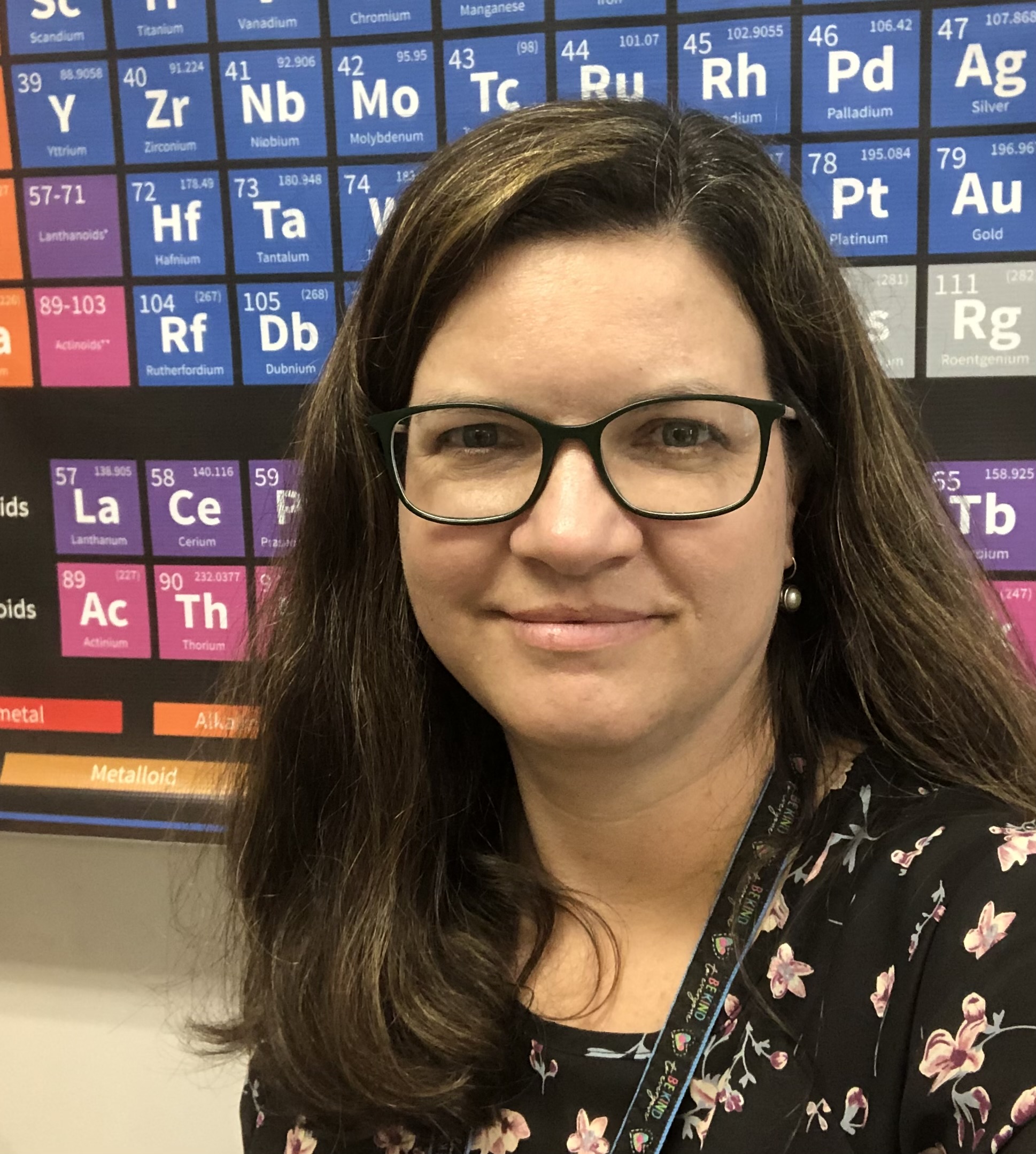
Kate Sharer
Georgia Tech alumna Kate Sharer is helping high school students move beyond textbooks to explore scientific challenges usually reserved for university and industry researchers.
Most high school students spend their science classes learning established concepts and completing the occasional lab experiment. At Lambert High School in Forsyth County, Georgia, students on the school's International Genetically Engineered Machine (iGEM) team operate more like a research lab, working together to investigate ambitious real-world challenges in synthetic biology.
The iGEM students are led by Catherine "Kate" Sharer (Chemistry/Biochemistry 1996), who discovered a passion for research as an undergraduate at Georgia Tech.
“It's a joy to work with these students on real science. Instead of teaching a class, it feels very much like we're running a research lab that also has this competitive aspect to it,” says Sharer. "It's the perfect job I never knew I wanted."
Georgia Tech Beginnings
Sharer’s path to the classroom began in Tech’s chemistry labs. She initially enrolled as a chemical engineering major, before discovering she preferred chemistry and the lab work that went with it.
“I would listen in class and memorize my notes, but I learned the most when I could put chemical theories into practice in the lab,” says Sharer. ”Today, I try to bring that same learning process to my students.”
Summer research positions with Georgia Tech faculty gave her opportunities for hands-on scientific discovery. “Working in labs as a 19-year-old undergraduate made a huge impact on me,” Sharer says. “I absolutely fell in love with research.”
After graduation, she began a Ph.D. program in biochemistry and molecular biology at Emory University and spent about a decade in research labs. During those years, she mentored undergraduate scientists and found her enthusiasm for teaching matched her passion for research.
Realizing she wanted to make teaching a career, she earned a master's degree in secondary education and became a chemistry teacher. Just two years later, iGEM showed her that she didn't have to choose between the classroom and the lab.
Global Acclaim
The iGEM competition brings together students from more than 65 countries to conduct ambitious research aimed at solving real-world problems, culminating in the annual Global Jamboree in Paris.
The Lambert team is internationally recognized. Over the years, they’ve been profiled on 60 Minutes and Georgia Public Broadcasting and earned several competition awards. The 2022 team won the Grand Prize with their project, CADlock, an accessible, early-diagnosis screening test for coronary artery disease that uses microRNA biomarkers.
Nearly 100 students tried out for 10 openings on this year's team. According to Sharer, families move to the Lambert School District to participate. Despite the accolades, Sharer believes the team’s greatest achievement is the growth she sees in her students.
“They gain a lot of soft skills, like being a good team member and an effective communicator,” says Sharer.
Addressing Challenges
Each year the students choose the global issue they’d like to tackle.
The 2025 team developed a Lyme disease diagnostic platform using gene-editing technology, which led to an invitation for students to present their research at a Lyme disease symposium at Johns Hopkins University.
"This wasn’t a competition, this wasn’t on 60 Minutes, this wasn’t for a gold medal. This was my students being part of an important conversation with Lyme disease researchers across the world,” says Sharer. “It really showed them the power of science.”
This year's team is focusing on deformed wing virus in honey bees. Students are exploring synthetic biology approaches that could help protect bee populations critical to agriculture.
“My students are passionate, competitive, and committed to making the world a better place through the research and outreach that they do,” explains Sharer. “They’re wildly creative and ambitious, without any preconceived notions of what they can’t do.”
Beyond the laboratory, Lambert’s iGEM students host a synthetic biology summer camp for middle school students, conduct outreach in local schools, and even deliver virtual lessons to young women in Afghanistan.
All of the iGEM experiences have reinforced Sharer's belief in what young scientists can achieve:
"High school students are capable of independent research, and the more opportunities we can give them for that, the better."
A Georgia Tech Legacy
Like Sharer, the Lambert iGEM team shares strong ties with Georgia Tech.
The team traces its roots to School of Chemical and Biomolecular Engineering Professor Mark Styczynski, who introduced former Lambert teacher, Janet Standeven, to the competition. Since then, Styczynski has remained a dedicated mentor, supporting Lambert students for more than a decade.
“He treats my high school kids like grad students, asking them great questions that make them think about the research," says Sharer.
Other Georgia Tech professors have also offered research guidance and laboratory space.
This year, the students have been working with Jennifer Leavey, principal academic professional, assistant dean for faculty mentoring, and director of the Georgia Tech Urban Honeybee Project.
“I’ve been very impressed with the Lambert iGEM team members,” says Leavey. “They are approaching the problem of honey bee health from so many different angles — using molecular biology, protein chemistry, technology, and even education. I hope they all become scientists, but even if they don't, I know they will go on to amazing things!”
Coming Full-Circle
Sharer sees her own educational experience reflected in the opportunities her students have today.
“Everything I was taught at Georgia Tech, my training at Emory, and all of the pieces of my education, I get to transfer into the classroom,” says Sharer.
Many iGEM students leave Lambert and come to Georgia Tech. Esther Lee, a third-year biomedical engineering major, was a member of the Lambert iGEM team in 2022 and is now a volunteer mentor.
“The endurance built from reading papers, troubleshooting, and collaborating with team members to be creative and solve problems helped me push through challenging courses and team-based projects at Tech,” says Lee. “It also encouraged me to join a research lab and continue experimenting.”
Lee speaks highly of her former advisor:
“Ms. Sharer expertly balances encouraging and pushing students to learn, explore, and ideate challenging topics while also keeping realities and timelines in check,” says Lee.
Sharer’s current iGEM students agree:
“She’s a great teacher,” says Brandon Jimerson, a senior member of Lambert’s iGEM team. “She’s really shaped the way I look at science and how it can positively affect the world.”
Additional Images
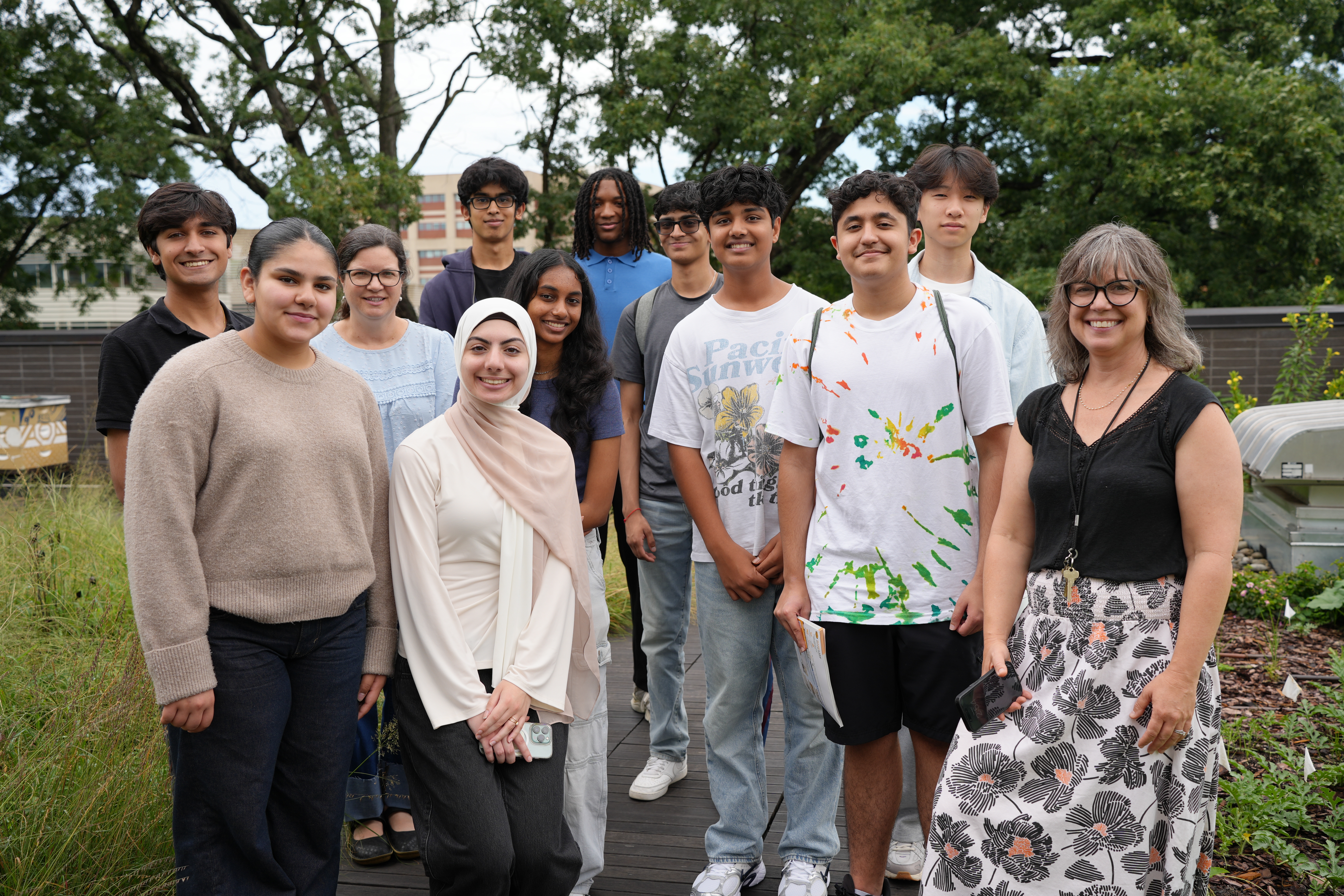
<p>Lambert High School iGEM members visited the hives located on the roof of the <a href="https://livingbuilding.gatech.edu/">Kendeda Building for Innovative Sustainable Design</a> and took part in a question and answer session with Director of the Georgia Tech Urban Honeybee Project Jennifer Leavey.</p>
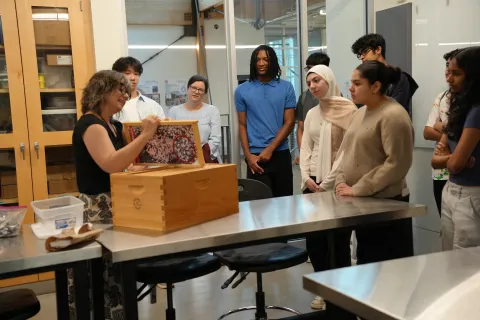
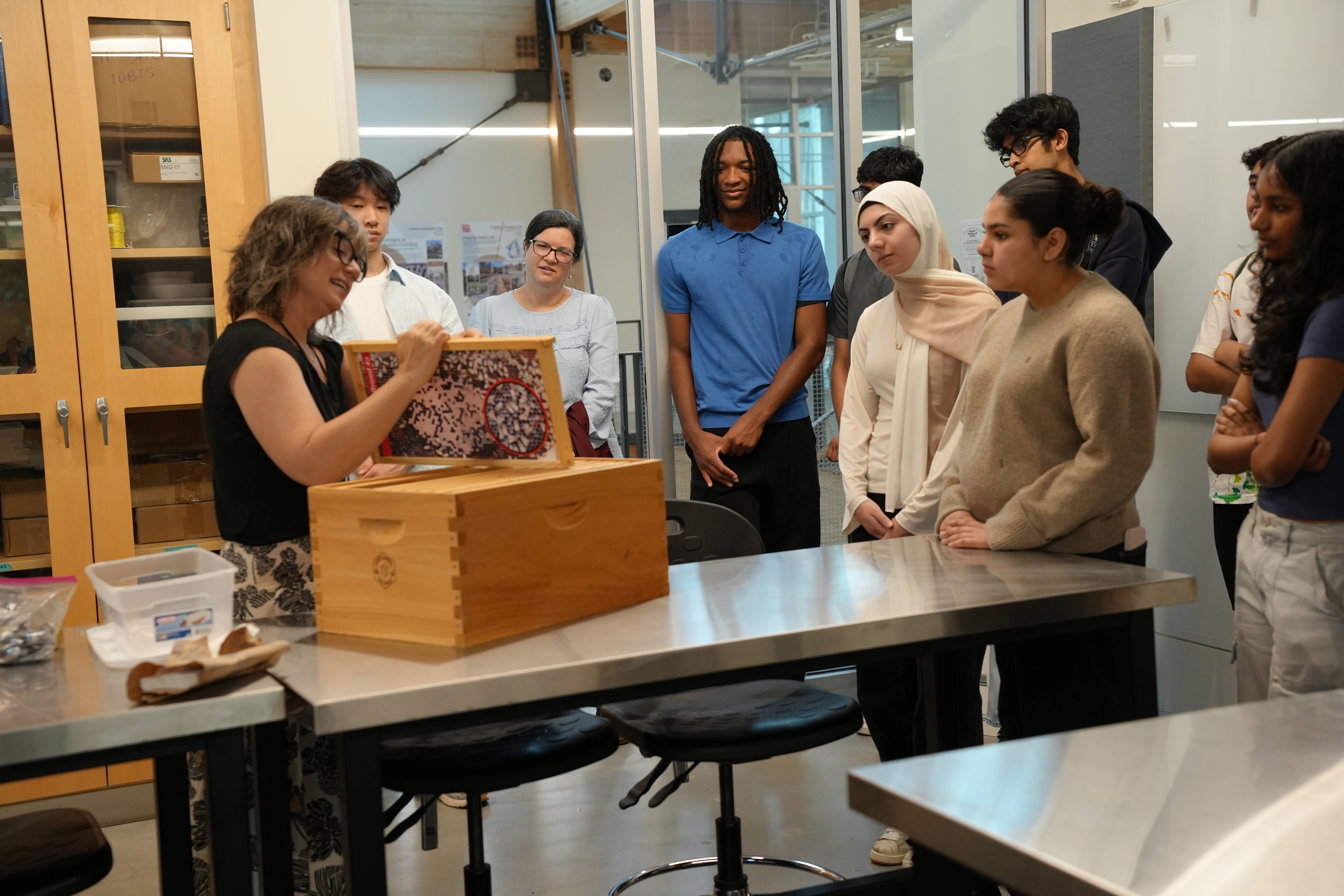
<p>Lambert iGEM students and Leavey discuss different ideas to treat the mites that often spread deformed wing virus without harming the hive.</p>